
Jiangsu China travel destination Sleeping Buddha Temple Sleeping Buddha Temple. View more details including related videos clips reviews comments and rating.
View 1 of these 1 photos, or you can help us upload shares your photos in the comments area, please share your experience with others.
The Temple of Sleeping Buddha, located at the foot of the Longevity Hill, together with the Fragrant Hill, the Temple of Azure Clouds and the Beijing Botanical Garden forms a popular tourist area, about 30 kilometers west of Beijing. It was first built in the Reign of Zhenguan (627-649) in Tang Dynasty, named the Temple of Longevity which renovated and renamed in Yuan, Ming, and Qing Dynasties. In the Year 12 of the Reign of Yongzheng, it was given another name: the Temple of Universal Awakening. Because the temple is noted for its huge statue of recumbent Buddha cast in Yuan Dynasty, it is generally referred to as the Temple of Sleeping Buddha.
As a classical Buddhist temple, it has a compact overall arrangement and buildings are arranged along the medial axis symmetrically. It consists of three courtyards which stand one after another in the medium axis and six side hall lies in the east of the medium axis. The main buildings include the Temple Gate, the Hall of the Temple Gate, the Hall of Heavenly King, the Hall of Buddha of Three Ages, the Hall of Sleeping Buddha, and the Depository of Buddhist Text.
Walking through the way lined by towering ancient cypresses, visitors will see the Temple Gate, a marble made archway, crowned with glazed tiles of various shapes and colors. Passing it, the first courtyard is in sight.
There is a little pond in the shape of crescent with a Stonebridge spanning it. The Bell Tower and Drum Tower erect systematically on each side of pond. The Hall of the Temple Gate is right behind them. It houses the Two Ferocious Gigantic Guardians, also known as Heng and Ha. They are also called Vajras, which mean indestructibility and irresistibility. They are the heavenly gods to protect the Buddhist doctrine, holding the vajras( an ancient Indian weapon) in their hands.
In the second courtyard lies the Hall of Heavenly Kings. It houses a statue of Maitreya Buddha right in the middle. There are four statues of heavenly Kings in the hall. The second courtyard has a calyx canthus planted on the left of the Hall of Heavenly Kings. It is in full blooming every winter with its fragrance diffusing all around, which has become a feast to visitors’ eyes. Two bodhi trees are planted on each side of it. According to legend, Skamania gave instructions to his disciples under the bodhi tree while he was ill. Therefore bodhi tree is also called the Sacred Tree.
The Hall of Buddha of Three Ages, behind the Hall of Heavenly Kings, houses three statues of Buddha and Eighteen Arhats.
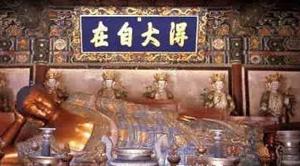
Standing after the Hall of Buddha of Three ages, the Hall of Sleeping Buddha is the most important building in the temple. It houses a copper statue of Buddha in recumbent posture. It used to be a woodcarving made in Tang Dynasty and changed into a copper statue in the first year in the Reign of Zhizhi in Yuan dynasty (1321). The Sleeping Buddha, 5.3 meters in length, is in reclining posture with one arm straightened and the other arm turned to support the head. It was claimed that 54 tons of copper was used to cast the enormous statues at a cost of 50 million silver taels. There are 12 small statues around the Sleeping Buddha, which said to be the disciples of Skamania and they are listening Skamania’s instructions. Besides, there are eight treasures of Buddhism “the wheel, spiral shell, umbrella, canopy, flower, vase, fish, and knot” displayed in the hall symbolizing good luck.
There is a Peony Garden located in the west of the Temple of Sleeping Buddha, with an area of about 10,000 square meters and more than 2000 peony trees. When they are in full blooming, the scenery is very spectacular.
top
We uses YouTube API Services. https://www.worldtraveldb.com/youtubes-terms-of-service/
[tubepress mode=’tag’, tagValue=’Sleeping Buddha Temple china’]