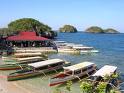
 Like an ambitious and beautiful pageant winner unwilling to relinquish her crown, Boracay primps and preens year after year, going through its own version of cosmetic surgery in the off-season in order to maintain its crown as the trophy beach of the Philippines. Despite oft-heard nostalgic laments (‘In the ’80s, the only sound was from the fruit juice shaker machines’), Boracay, little more than a speck off the northwestern tip of Panay, still satisfies the planeloads of holidaymakers looking for sun, sand and nonsobriety. Of course no place (including White Beach, where the action is and all that most people see of the island) can ever live up to the hyped up superlatives bandied about by tourism-department officials. Hotels, restaurants and shops are crowded along the beach like spice shops in a Middle Eastern bazaar, and vendors selling watches, sunglasses, jewellery and boat trips do pester you like flies on honey, and the colourful paraws are sometimes lined up on the beach as if it were a mall parking lot. But all this aside, Boracay, which is only about 9km long and only 1km wide at its narrow midriff, is an intoxicating mix of yes, sun, sand and nonsobriety.
 Diving, drinking and dining (in that order) top the list of activities in the dive colony of Moalboal (hard to pronounce – try mo-all-bo-all). About 90km from Cebu City, Moalboal proper is on the main road – the part that tourists mean when they say ‘Moalboal’ is actually Panagsama Beach, a resort village a short, bumpy tricycle ride west of town (day/night P30/60).
  This little island off Cebu’s northern tip has been growing steadily more famous over the years for its long, white beaches, great food and low-key approach to tourism. There are, or were at the time of writing, no cars or paved roads on the island, only a network of walking tracks. These tracks wind past such humble attractions as the waterside town cemetery, with its sun-bleached graves, the lighthouse on the island’s northwest, and the 12m-high lookout up near Los Bamboos, which some brave/foolhardy souls treat as a cliff jump.
  Iloilo (ee-lo-ee-lo) City, the hub of Panay once known as the Queen City of the South, is the most cosmopolitan city in the Visayas after Cebu. It has a compact, walkable downtown, a relatively vibrant nightlife and music scene fuelled by the student population, and an excellent choice of accommodation and restaurants. It’s a logical base for combining a trip to Boracay with Guimaras, which is only a short hop away. ‘Downtown’ Iloilo City is surrounded by three old suburbs: Molo, Jaro and La Paz (la-pass).
  If you were beginning to develop an aversion to regional centres, you’re in for a pleasant surprise with Dumaguete. It’s a nice place. Seriously. Everyone raves about the Rizal Blvd promenade, and it’s true there’s something genuinely charming about this harbourfront ‘quarter mile’: the faux-antique gas lamps; the grassy median strip. But there are other things to like about Dumaguete: it’s big but it feels small, and it’s less congested, less polluted and – being a university town – far more hip and urbane than your average provincial capital.
  As far as most visitors are concerned, Cebu City is Manila minus the mayhem. Its traffic is chaotic, but not insane. Its size and layout can actually be understood, rather than merely endured. And – sigh – hardly any of the taxi drivers here are employed by Satan.
  Cebu is the hub around which the Visayas revolves. It is the most densely populated island in the Philippines and is second only to Luzon in its strategic and economic importance to the country. Its language, Cebuano, is widely spoken throughout the Visayas and parts of Mindanao, and its capital, Cebu City, is a magnet for migrants from all over the region.
  The sound you hear in Catbalogan is silence, at least compared to most tricycle-clogged towns. Only pedal power is allowed in the centre, which added to the fact that Catbalogan has the best choice of accommodation on the island, makes it the most logical place to base yourself if you intend to explore the interior. There’s an impressive looking city hall. Catbalogan is the provincial capital of western Samar, and in the middle of Pita Park, a little patch of greenery not far from the port, there is a memorial to the Doña Paz ferry disaster. Most of the victims were from Catbalogan and elsewhere on Samar.
  In most tourism brochures a bug-eyed tarsier clinging to a tree superimposed on a background of the Chocolate Hills is shorthand for the island of Bohol; it seems white sandy beaches are too common to warrant inclusion. While this distinctive pairing draws the domestic crowds, it’s the lush jungle interior, rice terraces and offshore islands, most prominently Panglao Island and its great diving, which truly captures the imagination of travellers; a tour of the towns will reveal some of the country’s best examples of colonial Spanish churches, many of which are made from coral stone. Bohol is also known for its ube or ubi (yams), the bright-purple sweet potatoes that give halu-halò (various fruit and vegetable preserves served in shaved ice and milk), the national dessert, its distinctive colour and flavour.
  With an airport, a sea port and a host of bus and jeepney terminals, Bacolod is little more than a transport hub to most travellers. But if you have the time, it does have a couple of sights you can see inside of a day.