
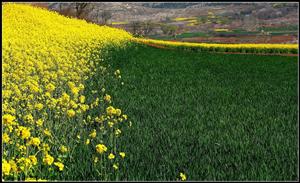
Hebei China travel destination Huangcang Valley Suzhou Attraction. View more details including related videos clips reviews comments and rating.
View 1 of these 2 photos, or you can help us upload shares your photos in the comments area, please share your experience with others.
Huangcang Valley, or the Emperor Hideout Valley, is a part of the Shandong Hills, running from north to south, with a highest altitude of 374 meters and an average altitude of 100 to 300 meters. The hilltops are quite flat and the hillsides are relatively steep. The valley was once called Huangsang Valley (which means Yellow Mulberry Valley) because there are many yellow mulberry trees growing on the hills. But the Emperor Liu Bang, or Gaozu, of the Han Dynasty once hid there in order to escape from an attack by the Qin armies, so the name of the valley was changed to Huangcang Valley, which means the Valley Where the Emperor Hid. It was recorded in the book Han Shu that “When Gaozu Emperor of the Han dynasty was still a humble man, he retreated in the Mangshan Mountains and Dangshan Mountains. The Emperor Hideout Valley, located among these mountains, was a refuge for Gaozu Emperor of the Han Dynasty.”
Ruiyun Temple
Ruiyun Temple is built on the mountain side, with its back to the cliffs and facing the deep valleys. The construction of the temple was started in the Jin Dynasty and it was reconstructed in the Tang Dynasty. Its old name was Huangsang Temple. The buildings in the temple are dived into three sections and three courtyards, which are composed of more than 90 rooms. The forecourt is the Depositary of Buddhist Texts, which is full of carved beams and painted rafters. The main palace has a wide open yard with tall figures of the Buddha. Dormitories for the monks are in the backyard. A large ginkgo tree, which is more than 1,300 year old, still stands in the forecourt, and in the backyard there are many ancient cypresses.
Emperor Hideout Cave and the Rock flying from afar
There is a natural stone cave about 100 meters from Ruiyun Temple to the southwest. The cave is situated in a dangerously steep place and visitors must climb up for about 130 meters to get there. The floor is flat and the wall is smooth, and the top of the cave looks like a roof. The ten meters deep cave is entirely naturally formed and is warm in the winter and cool in the summer. Standing at the entrance of the cave, you can see the green mountains in distance and the running rivers in the valley. There is a huge rock at the entrance, that looks like it has come flying from far away, with four characters carved on the stone wall next to it: Dong Tian Fei Lai (Flying from afar to the cave). It is said when Liu Bang was defeated, more than 200 thousands of soldiers were lost, and Liu led his ten attendants to break out of the encirclement, to go hiding in this cave.
Other Scenic Spots: Drawing Sword Spring, Immortal’s Bed, Beauty Cave, Twin Dragons Spring, Guolao Cave, Bowl Washing Pool, Sightseeing Peak. All of these spots has their own characteristics.
top
We uses YouTube API Services. https://www.worldtraveldb.com/youtubes-terms-of-service/
[tubepress mode=’tag’, tagValue=’Huangcang Valley china’]