
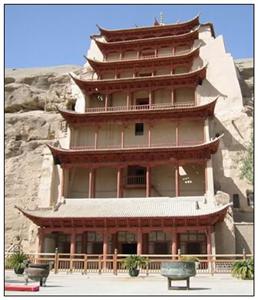
Beijing China travel destination Mogao Grottoes Dunhuang Attraction. View more details including related videos clips reviews comments and rating.
View 1 of these 2 photos, or you can help us upload shares your photos in the comments area, please share your experience with others.
The Mogao Grottoes, another Chinese “Thousand Buddha Caves”, are situated about 25 kilometers southeast of the city of Dunhuang, in present-day Gansu Province. The Mogao Grottoes are inarguably the most famous grottoes in China, and are considered the greatest treasure-trove of Buddhist art found anywhere in the world. They have also been praised as “a glittering pearl that adorns the Silk Road”, a reference to the fact that Dunhuang, initially only a stopover point – albeit, an important one – on the Silk Road, quickly became a Buddhist learning center, where Buddhist sutras and other Buddhist texts were translated into Mandarin, to be spread from there to other cities throughout China.*
The grottoes are carved out of the sandstone cliffs of Mingsha Mountain, and extend some 1600 meters from north to south. These grottoes were constructed over a period of a thousand years, from the 4th to the 14th century CE.** The remaining Mogao Grottoes (only a little more than half of them are still intact) contain some 45,000 square meters of mural paintings, and more than 2000 painted sculptures.
The first grotto at Mogao was chiseled in CE 366. According to legend, the area that comprises the Mogao Grottoes was marshland at the time, and a monk by the name of Yue Zun, traveling home across the region, had a vision-like dream in which a thousand golden Buddhas figured, therefore the monk decided to turn his dream into a reality, and the work on the grottoes then commenced.
Over the next thousand years, which saw the rise and fall of not less than sixteen imperial dynasties, the work of chiseling out the grottoes and of adorning them continued. The construction of the last grotto was completed during the Yuan (CE 1279-1368) Dynasty. As with the Western Thousand Buddha Caves on the north bank of the nearby Dang River (only 9 of whose original 22 caves are in a state suitable for public viewing), a large percentage of the original Mogao Grottoes were badly damaged; of the 735 original grottoes at Magao, only 492 of them have “survived”. Still, a very large number of the Mogao Grottoes are intact, something that not only Buddhists are thankful for, but also art lovers and archeologists the world over, as well as anyone who appreciates the significance of these grottoes and their contents for the cultural evolution – the civilization, if you will – of mankind in this corner of the world.
¤¤¤¤¤¤¤¤
* To gain a better insight into the role of Dunhuang for the spread of Buddhism in this part of China, one should also read the article that describes another of Dunhuang’s famous grottoes, the Western Thousand Buddha Caves.
** Though Buddhism made its official debut in China in CE 67, it spread slowly initially, only gaining speed after the collapse of the Han (BCE 206 – CE 220) Dynasty and the beginning of the Three Kingdoms (CE 220-280) period of small-state rivalry. Whereas Taoism had been associated with at least one instance of insurrection against the emperor (the so-called Yellow Turban, or Yellow Scarves, Rebellion of CE 184, a widespread peasant rebellion provoked by harsh taxation combined with governmental corruption), Buddhism was considered to be accommodating not only towards other religions, but also towards existing social structures, including the Chinese Imperial Dynasty system. With the acceleration in Silk Road trade, especially westward, beginning in the 4th century CE, the spread of Buddhism eastward along the Silk Road, and then throughout the rest of China, also accelerated.
top
We uses YouTube API Services. https://www.worldtraveldb.com/youtubes-terms-of-service/
[tubepress mode=’tag’, tagValue=’Mogao Grottoes china’]